
🦀 Finally A Full-Stack Rust Framework
Today’s issue: Open-Sourcing Buzz, Why Tokio Prioritizes Progress Over Order, and Hardening Rust Code for Production

Hello Rustaceans!
In this issue, we cover the new full-stack Rust framework, spotlight a project, and highlight 10 awesome links of the week.
Here’s issue 129.
MAIN NEWS
Finally A Full-Stack Rust Framework
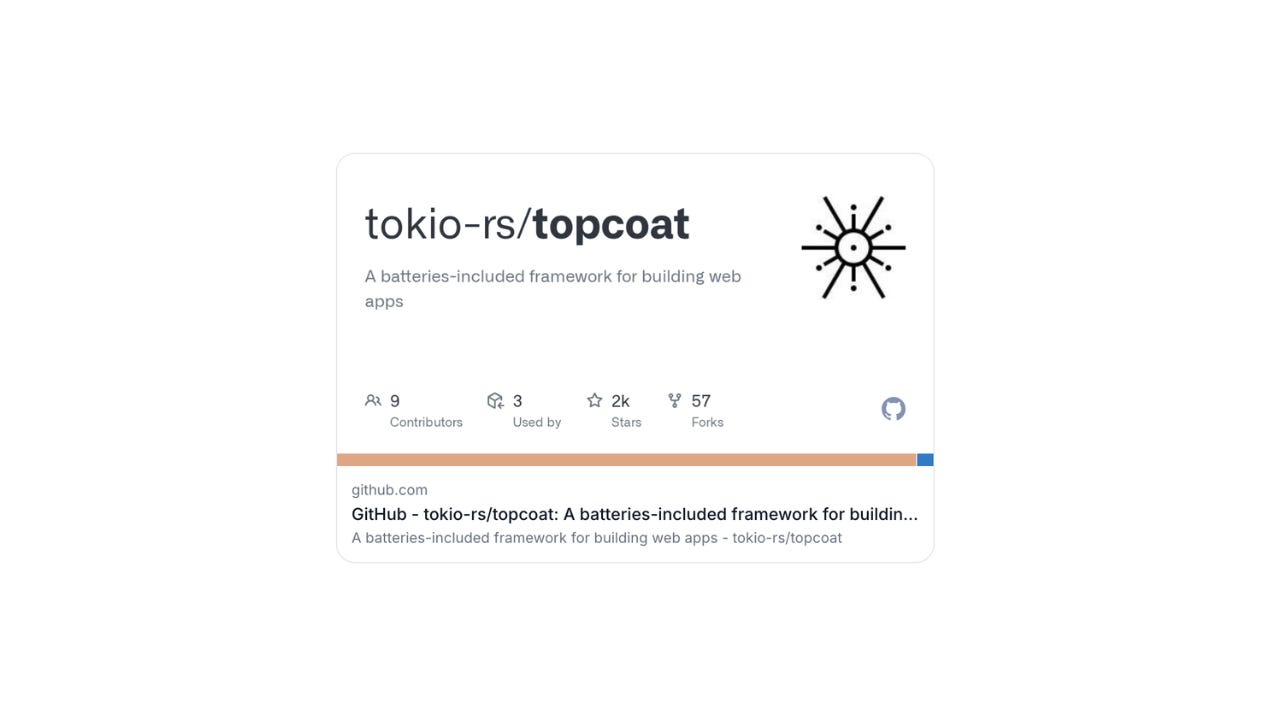
They say good things happen to those who wait, right? Well last week the Tokio team (yes, those behind Axum) open-sourced topcoat repo because they ran out of private CI credits. Win for all of us.
I know you might be wondering how it’s any different from Axum? Axum is the lean router; Topcoat is the opinionated full-stack layer on top, think server-rendered reactivity, components, and batteries like Django, without touching browser JS.
Topcoat’s magic lies in their server-rendered everything with HTMX/Datastar vibes. You write async components that can query your DB directly, put in some $(...) expressions, which compile to both Rust and tiny JS snippets, and you get reactive updates without the WASM tax or separate API layer.
Need a search that updates live? Mark it a #[shard], re-render on the server, swap the HTML. Topcoat UI even gives you Shadcn-style components you can actually edit, plus built-in Tailwind and asset bundling that scans your binary. Pair it with their Toasty ORM and you’ve got a proper full-stack story.
It’s not perfect yet, roadmap’s packed with admin panels, auth, email, OpenAPI, and more, and some are side-eyeing the macro-heavy syntax or debating if it’s real Rust. But for teams already shipping Rust infra who just want to ship web apps in the same language this is a game changer.
No more context-switching tax, full type safety end-to-end, and performance out of the box. Loco.rs exists, Leptos does the WASM dance, but Topcoat feels like the ‘I just want it to work well’ option.
If you’re tired of Python or JS fatigue, Topcoat is the one to watch. Early days, but the first code snippets already look productive.
PROJECT SPOTLIGHT 💡
datafusion
DataFusion is an extensible query engine written in Rust that uses Apache Arrow as its in-memory format.
You need lightning-fast SQL or DataFrame queries on your own weird data shapes, but existing tools are either too rigid, or painfully slow on modern hardware.
What makes it legitimately awesome:
Insanely customizable: Tweak almost anything, add your own data sources, functions, operators, or query languages.
Vectorized, multi-threaded execution that doesn’t suck: Columnar, streaming, partitioned processing. Parquet, CSV, JSON, Avro? Handled out of the box.
First-class APIs in multiple languages: Rust for speed freaks, Python and Java bindings for the rest of us who occasionally touch other ecosystems.
DataFusion is open-source at https://github.com/apache/datafusion.
AWESOME LINKS OF THE WEEK 🔗
The Rustaceans at Block open-sourced Buzz, a self-hostable workspace where humans and AI agents share the same rooms.
Khashayar wrote why Unbounded channels hide overload until OOM kills the process; prefer explicit bounds with backpressure, memory is always the real limit.
Sergey argued std::simd::swizzle_dyn was slow and limited, his improved algorithms for wider vectors and AVX2 deliver up to 6× speedups once synced.
David open-sourced a Rust+Bevy space-economy sim with autonomous ships, markets, factions and populations run a living solar system you simply observe. It’s cool.
Tree-sitter was rewritten in Rust and made 30% faster. Read how ast-grep did the rewrite and their findings.
Pranitha explained why Tokio prioritizes progress over order, unbounded fan-out mixes tasks and spikes memory, so bound concurrency yourself for fairness and lower peak usage.
Sniffnet v1.5.1 is out and it adds connection latency display, Hungarian and Sinhala translations, better IP blacklist support, and several fixes.
Nick from Bytecode Alliance wrote GC and Exceptions in Wasmtime. Wasmtime 47 enables Wasm GC and exceptions by default, letting high-level languages target WebAssembly more efficiently without custom collectors.
Matthias published Hardening Rust Code For Production, arguing that panics, limits, timeouts, and runtime security must be deliberate design choices rather than afterthoughts.
Savan’s ‘mmap behind the scenes in a database’ shows how mmap shines in append-only databases because immutable segments avoid dirty-page and recovery issues, letting the kernel manage caching effectively.
CodeCrafters: Become a Better Rust Engineer
CodeCrafters created amazing Rust courses that push your skills beyond the basics.
You’ll have fun building real-world projects from scratch, including Git, Docker, Redis, Kafka, SQLite, Grep, BitTorrent, HTTP Server, an Interpreter, and DNS.
The courses are self-paced, so you can learn at your own speed.
Join for free and get 40% off when you upgrade. [affiliate]
X | BlueSky | Mastodon | GitHub | LinkedIn | Buy us coffee | hello@rustbytes.com
Wish you the best end of the month and remember to exercise and take time off the screen.
See you next week!
John & Elley.
Why are we acting like Dioxus doesn't exist?