
🦀 Oxidizing PHP Toolchain
Today’s Issue: Proposal To Officially Introduce Rust Into Git, Rust 1.90.0 Stable Release, and How to Save $327.6 Million Using Rust

Hello, Rustaceans
The past few weeks have been filled with unusual headlines. I hope you're staying safe. Let's go!
In this issue, we'll take a look at a Rust project designed to improve PHP tooling, present a Q&A interview, spotlight an amazing Rust project, and share 10 incredible links of the week.
Here’s issue 85 for you!
MAIN NEWS
🦀 Oxidizing PHP Toolchain
It’s no doubt Rust has quietly become the go-to choice for building fast, reliable developer tools. Over the past few years, we’ve seen projects like SWC, oxlint, and biome for the JavaScript ecosystem, while uv has taken on Python’s dependency management issues with impressive results.
Now, the Rust-powered wave has reached PHP with the project Mago, a project designed to modernize and unify the PHP toolchain.
Despite being one of the most widely used languages on the web, PHP’s tooling story has often been inconsistent.
PHP developers typically rely on a patchwork of different utilities: PHPStan for static analysis, Psalm for type safety, CodeSniffer for coding standards, and various formatters or linters to fill in the gaps.
Each tool has its strengths, but the experience can feel fragmented, requiring developers to configure and maintain multiple moving parts.
Mago’s goal is to fix that by bringing everything into a single, cohesive package with the performance guarantees and reliabilities of Rust.
Here’s why Mago is reshaping PHP toolchain:
Mago is the fastest of today’s PHP tools, meaning less waiting and more coding.
It’s an all-in-one linter, formatter, static analyzer, semantic checks, and even AST visualization, no more juggling separate tools.
Smarter automation to automatically fix many common linting issues and enforce consistent formatting out of the box.
If you’re a developer working with PHP, this could mean less reliance on a patchwork of separate utilities and more confidence in a single, well-structured solution.
While tools like PHPStan, Psalm, and CodeSniffer have made important contributions, Mago’s goal is to unify and enhance these efforts, drawing lessons from both the PHP and Rust communities.
PHP may still be the workhorse of the web, but with Rust in the mix, its tooling finally feels like it’s catching up to modern expectations.
RUST Q&A INTERVIEW 🦀
Q: What excites you most about Rust’s future in the next 5 years?
A: ‘I'm really excited to see Rust in both Windows and Linux. It having such wide impact on operating systems is nice to see happen; for a language that has a lot of low-level capabilities, being at this layer of the stack is the ultimate test of usefulness, and so seeing uptake there has been great. Over the next five years we'll see the actual real-world impact of that work that's happening now.’
Q: What’s one feature you’d love to see added to Rust soon?
A: ‘I'm actually in a really conservative position here! I don't really think Rust *needs* any huge features in the near future, my projects are all happily on stable.’
About the Respondent: Steve Klabnik is a Rust contributor and co-author of *The Rust Programming Language*, and previously worked on Ruby on Rails.
Connect with Steve: BlueSky, Blog, GitHub.
Help Us Improve Rust Bytes
We just launched a short survey to better understand your needs and how we can make Rust Bytes even more useful (and fun) for you.
Your feedback means a lot, take a minute to share your thoughts.
PROJECT SPOTLIGHT 💡
Daft
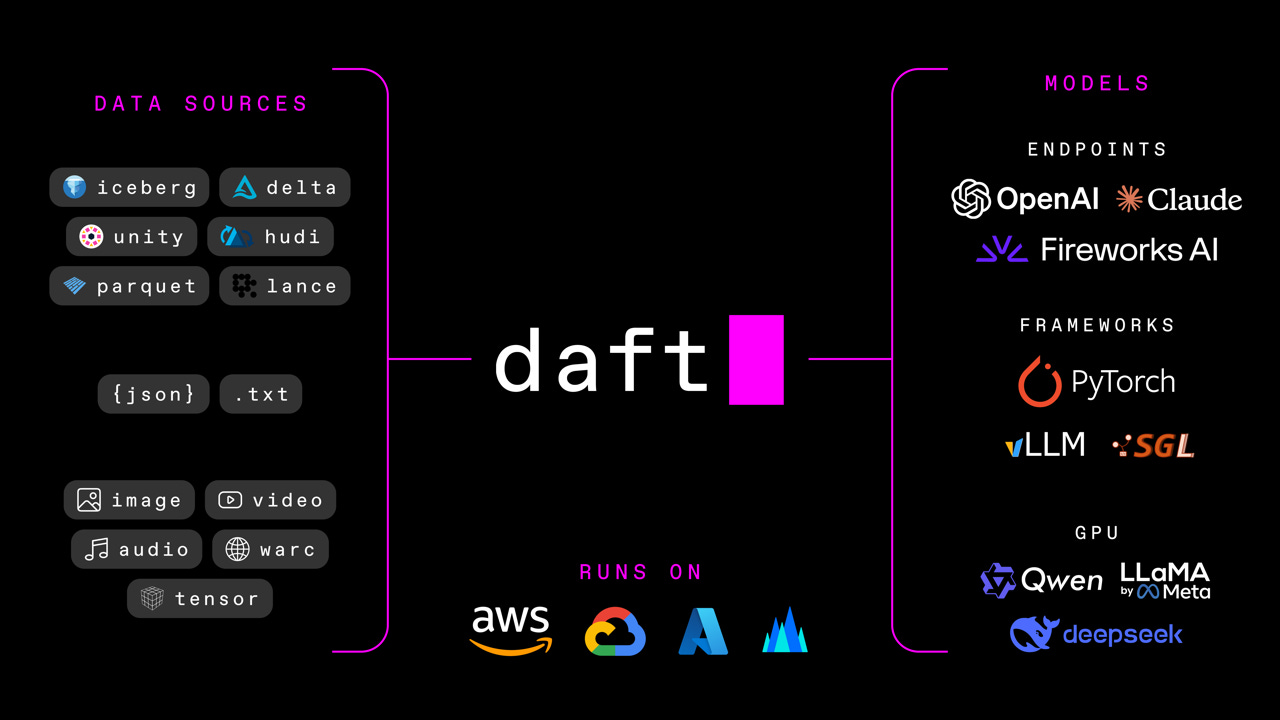
Daft is a distributed query engine for large-scale data processing using Python or SQL, implemented in Rust.
Most data tools are either lightning fast or flexible, rarely both. Pandas starts choking the moment you scale past your laptop’s RAM, Spark is powerful but can feel like piloting a cargo ship when you just want a kayak, and Polars? Great, but not exactly tuned for juggling tensors, images, and text all in the same table.
Daft steps in to bridge that gap: scale, speed, and multimodal support, without making you hate your life.
Here’s what makes Daft worth your attention:
Any Data – Daft supports CSVs, Parquet, PDFs, images, audio, tensors, and more, all loaded into a dataframe structure for easy processing.
Scales Efficiently – Integrates with Ray to handle workloads that exceed local machine limits, scaling across clusters with CPUs and GPUs.
Flexible Interfaces – Offers both a Python API for iterative development and SQL for analytical queries.
Optimized for the Cloud – Delivers high I/O performance with S3 and uses Apache Arrow for efficient in-memory data representation.
Daft is open-source on GitHub at https://github.com/Eventual-Inc/Daft.
AWESOME LINKS OF THE WEEK 🔗
Rust v1.90.0 got released and introduces LLD as the default linker for x86_64-unknown-linux-gnu, adds Cargo workspace publishing, demotes x86_64-apple-darwin to Tier 2, stabilizes new APIs, and enhances const context support.
AWS Labs open-sourced Metrique, a crate that monitors and logs detailed program performance metrics, such as task duration and event frequency.
Thomas Karatzas released RustGPT, a full-blown LLM coded in pure Rust. No ML frameworks, just raw ndarray matrix magic.
After 16 months of development, Diesel 2.3.0 is finally here, bringing easier query construction, support for window functions, and more.
Drew from Filtra interviewed David Wood, Rust Team Lead at Arm, about Rust–Arm compatibility, Arm’s growing investment in Rust, its role in embedded systems, and recent compiler advancements.
Carter Anderson (creator of the Bevy Engine) wrote a community reflection on Bevy’s fifth year.
Chris Boette’s How to Save $327.6 Million Using Rust might just be the ultimate read if you’re on a cost-cutting spree.
Jan David Nose from Rust’s Infrastructure team discussed the systems behind Rust’s development and crates.io, CI/CD tooling, and the importance of secure supply chain infrastructure. [video]
Patrick Steinhardt filed a proposal to officially introduce Rust into Git’s codebase and eventually make it a mandatory part of building Git starting with Git 3.0.
If you've struggled with parsing in Rust, Jan Procházka's guide, A Practical Introduction to Parsing, will help you avoid the headache.
CodeCrafters: Become a Better Rust Engineer
CodeCrafters created amazing Rust courses that push your skills beyond the basics.
You’ll have fun building real-world projects from scratch, including Git, Docker, Redis, Kafka, SQLite, Grep, BitTorrent, HTTP Server, an Interpreter, and DNS.
The courses are self-paced, so you can learn at your own speed. If you’re itching to level up your Rust skills, these courses are perfect for you.
Join for free and get 40% off when you upgrade. [affiliate]
SUPPORT RUST BYTES
You’re Rust Bytes’ biggest fans, and we love to see it.
Here’s how you can help:
❤️ Recommend Rust Bytes to your friends.
🤳 Connect with us on our socials: X, BlueSky, Mastodon, Publication.
☕️ Buy our editors a coffee.
📨 Email us at rustaceanseditors@gmail.com for sponsorship, feedback or ideas.
Been watching some podcast while writing this issue. See you in the next one.
That's all for now, Rustaceans.
John & Elley.