
🦀 Rust Wrapped 2025
Today’s Issue: RustConf 2026 CFP Is Open, We Somehow Made It to 100 Issues, and Someone Finally Said “What if FFmpeg… but Actually Rust?


Happy new year, Rustaceans
In this issue, we’ll provide a recap of how Rust faired in 2025, present you a challenge, spotlight an amazing project, and share 10 incredible links of the week.
Here’s issue 100 🎉
A Message for You
We crossed two milestones this week.
One, we made it into a new year. Two, and this one actually matters, this is issue #100.
That’s 100 weeks of shipping, curating, arguing with drafts, and hitting “send” knowing Rust developers don’t forgive mistakes.
We’d usually mark this with a giveaway, but a quick look at our bank balance says that’ll have to wait.
So thank you for reading, sharing, replying, and sticking around long enough to make a hundred issues possible.
Onward.
MAIN NEWS
Rust Wrapped 2025
Last year, the tech world was a full-on circus: blockbuster acquisitions, brutal layoffs, AI mania dominating every feed, and Rust popping up everywhere online.
So, grab your coffee, let’s rewind, and relive the stories that stole headlines, ignited flamewars, and kept the Rust community talking all year long.
First Quarter (Q1): January 1 – March 31, 2025
The year kicked off with the release of an updated Rust Trademark Policy, forcing even the most code-obsessed among us to dust off our reading glasses and read into legal fine print.
Meanwhile, the Roc programming language announced it’s shift from Rust to Zig, sparking endless debates and a few nostalgic sighs across the community.
The 2024 Rust Survey landed shortly after, revealing that company adoption had grown a modest but meaningful 4%, classic Rust: slow, steady, and deliberate progress.
Around the same time, the Rust 2024 Edition finally reached stability, bringing polished refinements with minimal breakage. The ongoing Rust-for-Linux saga also saw some cooling off as key figures stepped back from the fray.
On a brighter note, fan-favorite Rust startup Rerun secured a $17M seed round to evolve its multimodal data visualization tool into a full-blown Physical AI platform.
Finally, the async-std project officially reached end-of-life, with its maintainers graciously pointing the community toward smol as the recommended alternative.
Second Quarter (Q2): April 1 – June 30, 2025
Biome hit a major milestone with its v2.0 beta release, a huge payoff after two years of grinding. Not long after, the Rust Foundation made waves by ditching Twitter (now X) for Bluesky and Mastodon, and yeah…the timelines had feelings.
Around the same time, Boring Cactus released the State of Rust GUI 2025 Survey report, a refreshingly candid mix of cold-hard reality and genuine optimism about where GUI libraries stand.
The hits kept coming: Rust 1.88 shipped with let-chains officially stabilized, finally making those deeply nested conditionals a little less soul-crushing.
Hot on its heels, Canonical announced that Ubuntu would ship sudo-rs by default. This came right after Rust Week in Utrecht, where Rustaceans geeked out in person, and if you went, zero regrets, right?
Meanwhile, the rustc compiler quietly crushed a massive milestone: completing a full stage-3 bootstrap using the GCC backend.
And just like that, Rust officially landed in the Linux kernel with the 6.15 release, dropping its long-standing “experimental” tag.
Then the NSA weighed in, strongly endorsing memory-safe languages in a new report, coming a full 16 months after the White House’s push for secure software.
It was another loud signal that the industry and government are all-in on moving away from memory-unsafe code.
Third Quarter (Q3): July 1 – September 30, 2025
Turso kicked off the quarter with an alpha release of Project Limbo, a full Rust rewrite of SQLite that has the database world buzzing.
Around the same time, the Extended Standard Library (ESL) proposal dropped: a bold plan to officially certify a curated set of crates, giving them a trusted, “blessed” badge of reliability.
Adding serious academic heft, the long-awaited Tree Borrows paper landed at PLDI 2025, introducing a refined aliasing model that’s already reshaping how Rust thinks about pointers.
In a bittersweet moment for the ecosystem, Alex Crichton announced the archiving of the Rust and WebAssembly GitHub organization, a graceful sunset for a project that paved the way for so much Wasm innovation.
On a brighter note, Fedora quietly joined the Rust adoption wave by rewriting Greenboot in Rust, following in the footsteps of Linux and Ubuntu.
Rust held onto its crown as the “Most Admired Language” in the Stack Overflow Developer Survey for the tenth straight year, with 72% of respondents still head-over-heels for its memory safety guarantees.
Functional programmers got an early holiday gift when tail calls finally landed on nightly, courtesy of the become keyword and explicit tail-call codegen in the LLVM backend.
RustConf returned to Seattle, Washington, delivering standout talks, legendary hallway-track conversations, and those immaculate community vibes we all live for.
Meanwhile, the Rust Compiler Performance Working Group released the results of their latest survey, shining a light on the biggest performance bottlenecks and giving the team clear marching orders for improvements ahead.
Fourth Quarter (Q4): October 1 – December 31, 2025
The fourth quarter kicked off with a provocative bang: Jacob Hughes and Laurence Tratt from soft-dev.org dropped a paper titled “Garbage Collection for Rust: The Finalizer Frontier.” Borrow-checker purists collectively shivered, GC in Rust? That’s fighting words.
Around the same time, researchers at Edera disclosed a high-severity vulnerability (CVE-2025-62518) that allowed remote code execution through something as innocent as unpacking a .tar file. A sobering reminder that even in the Rust ecosystem, vigilance is eternal.
On the brighter side, Rust 1.91.0 arrived with Windows ARM64 graduating to Tier 1 support, complete with full test coverage and prebuilt binaries.
Meanwhile, Google’s Android team shared an impressive progress report: Rust code in the platform saw a stunning 1000× reduction in memory-safety vulnerabilities, clocking in at just 0.2 bugs per million lines compared to C/C++.
Not everything was smooth sailing, though. Cloudflare suffered its largest outage of the year after an overzealous .unwrap() in a recently rewritten Rust component on their edge network. Lesson learned the hard way: even safe languages can’t save you from panic-induced downtime.
Debian, clearly feeling the FOMO, announced plans to introduce hard Rust dependencies into APT, no earlier than May 2026.
Ferrocene v25.11.0 shipped with major advances in safety certifications, further cementing Rust’s credibility in regulated, safety-critical domains.
The quarter’s biggest fireworks came at the 2025 Linux Kernel Maintainers Summit: Rust officially shed its “experimental” label and went fully mainline. It’s core now, no asterisk, no caveats.
Wrapping the year, Rust 1.92.0 delivered genuinely solid improvements, proving the project never truly sleeps, even during the end-of-year hype blackout.
All told, 2025 was a great year for Rust, deep industry adoption, meaningful technical wins, and a reputation that keeps climbing.
Job opportunities continued their steady upward trend, though junior roles remain frustratingly scarce, still topping everyone’s wish list.
Looking ahead to 2026, we’re optimistic for even bigger leaps. But if Rust has taught us anything, it’s to expect the unexpected.
Either way, we’re strapped in and ready for whatever comes next.
Note: For sources, and all the references mentioned in this recap, see our companion links page.
RUST CHALLENGE 🦀
Last week we had you solve the Thread-Safe Counter challenge. Now, this week’s challenge.
Merging Magical Portals
As a wizard tending ancient magical portals, you track when each one opens and closes (given as `(open, close)` times, with pen < close).
Write a function that takes a list of these portal intervals and returns a new, sorted list of merged intervals, combining any that overlap or touch.
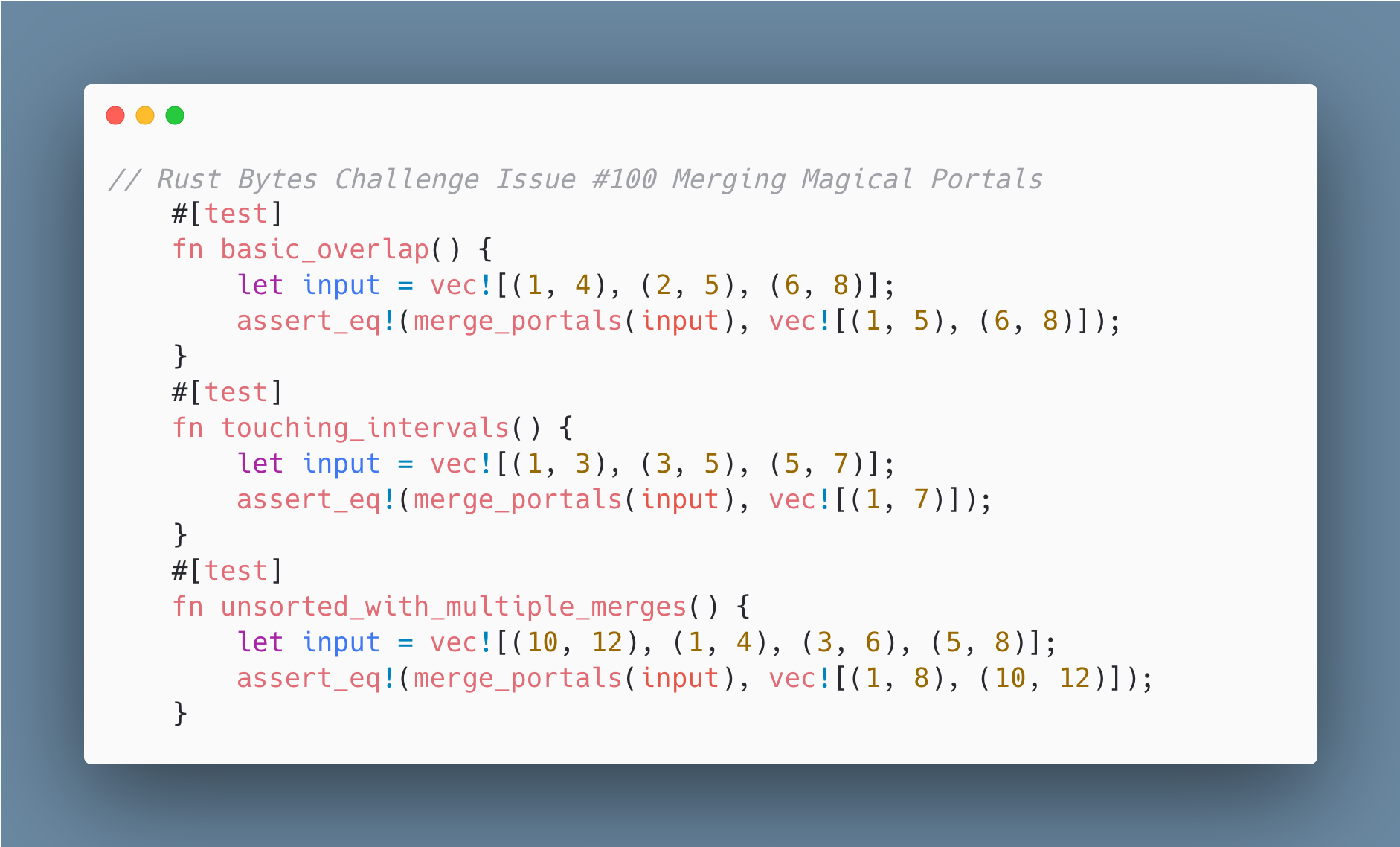
Test your solution on Rust Playground. Share your solution and tag us either on X, BlueSky, Mastodon, LinkedIn, or reply to this e-mail.
PROJECT SPOTLIGHT 💡
ATAC
ATAC is Arguably a Terminal API Client. It is based on well-known clients such as Postman, Insomnia, or even Bruno, but inside your terminal without any specific graphical environment needed.
The big headache ATAC swings at? Those modern API clients that lock your collections behind logins, force online sync for “collaboration” nobody asked for, and balloon into electron-powered memory hogs.
What makes ATAC downright awesome:
WebSocket support baked in - Send text/binary messages like it’s nothing, something Insomnia still fumbles while Postman plays catch-up.
Themes and remappable Vim bindings - Make it look pretty and feel like home if you’re a modal-editing wizard.
Insanely lightweight - Binary clocks in at 5-15MB, snappy as hell, with exports to cURL, Reqwest, Axios, and more for when you need to share.
It’s forever free, account-less, and offline, because who wants their API testing tied to some company’s servers?
ATAC is open-source and available on GitHub at https://github.com/Julien-cpsn/ATAC.
AWESOME LINKS OF THE WEEK 🔗
The Rustup team announced that Rustup 1.29.0 beta is now available, with a call for testing underway.
Kerim Buyukakyuz open-sourced corroded, a satirical crate that proudly does all the things Rust tells you never to do.
Ohad Ravid broke down why calling my asm function from Rust is slower than calling it from C.
Vincent Sgherzi argues for dependency-free Rust errors using std tools, trading verbosity for security, clarity, context, and explicit control.
Jakub Beránek recounts debugging flaky integration tests in the bors GitHub bot, where he traced mysteriously empty PATCH request bodies to a long-standing bug in octocrab’s default retry mechanism.
Got a wild Rust war story, a clever hack, or hard-won lesson? RustConf 2026 CFP is open, submit a talk and put it in front of the largest gathering of Rustaceans.
“No cars were harmed for this talk” by Frank Lyaruu is a downright inspiring deep-dive into real-world Rust use in automotive scenarios. [video]
Clayton Ramsey bragged about upcoming upgrades to dumpster, his garbage collection library.
Ralf Jung, Benjamin Kimock, Christian Poveda, Eduardo Sánchez Muñoz, Oli Scherer, and Qian Wang published a paper titled “Miri: Practical Undefined Behavior Detection for Rust” in the Proceedings of the ACM on Programming Languages (POPL 2026).
Yazalde Filimone did what many talk about and few actually do: open-sourced ffmpreg, a Rust-native multimedia toolkit that decodes, transforms, and encodes audio and video.
CodeCrafters: Become a Better Rust Engineer
CodeCrafters created amazing Rust courses that push your skills beyond the basics.
You’ll have fun building real-world projects from scratch, including Git, Docker, Redis, Kafka, SQLite, Grep, BitTorrent, HTTP Server, an Interpreter, and DNS.
The courses are self-paced, so you can learn at your own speed.
Join for free and get 40% off when you upgrade. [affiliate]
SUPPORT RUST BYTES
You’re Rust Bytes’ biggest fans, and we love to see it.
❤️ Recommend Rust Bytes to your friends.
🤳 Connect with us on our socials: X, BlueSky, Mastodon, LinkedIn.
☕️ Buy our editors coffee.
📨 Email us at rustaceanseditors@gmail.com for sponsorship, feedback or ideas.
Started the year on a high note, wish you a great year ahead.
That's all for now, Rustaceans.
John & Elley.