
🦀 What’s New in Rust 1.92.0
Today’s issue: Open-Sourcing Bytes, Rust for Linux’s First Vulnerability, and Rust’s Block Pattern

Hello, Rustaceans
We celebrated our second anniversary last week, and we couldn’t do this without you - thanks for reading.
In this issue, we’ll discuss the recent Rust release v1.92.0, present you a challenge, spotlight an amazing project, and share 10 incredible links of the week.
Here’s issue 98.
A Message for You
This year’s Advent Of code (AOC) ended last week and we would like to thank all the participants who took part in the Rust track on our private leaderboard.
A special shoutout goes to our top performers: Agnibha Chakraborty, jancha, beeb, jmgimeno, B14CK313, and Bryan, as well as Jamie Quigley, orangutron, djundjila, fistons, vitcra, sha90w, Tommy Han, Pavan Kumar Pothula, mikecluck, and WOANS who joined the fun.
We can’t wait to see you take part in the next year!
MAIN NEWS
What’s New in Rust 1.92.0
There were two bits of news from last week that really stood out to me.
First, GitHub rolled out some changes to GitHub Actions and chaos promptly followed. Think all-caps tweets, collective panic, and a speedrun in outrage. To their credit, GitHub noticed and quickly rolled the decision back.
If there’s one takeaway from that saga, it’s this: open-source communities still matter no matter how much corporate juggling happens behind the scenes.
Second, Rust v1.92.0 got released. It’s the last release of the year, and despite the usual end-of-year hype blackout, it delivered some genuinely solid improvements and features.
Here’s what’s worth mentioning from this release:
Never-type lints now mean business - The compiler now hard-stops code that relies on sketchy never-type fallbacks. About ~500 crates felt this. It’s not breaking, but it will make you fix things you were probably ignoring. Future-you will thank present-you.
unused_must_usechills out (finally) - No more warnings for ignoringResult<(), Infallible>. If an error literally cannot exist, Rust stops pretending it might.Backtraces are back—even with
panic=abort(Linux) - Panic aborts no longer mean flying blind. Unwind tables are emitted by default again, so your stack traces actually show up when things explode.Stricter checks for
#[macro_export] -Invalid macro attribute usage is now a deny-by-default lint. Translation: your macros either behave or the compiler tells you exactly why they shouldn’t.A pile of newly stabilized APIs - Zeroed allocation helpers (
Box,Rc,Arc), betterbtree_mapentry APIs,RwLockdowngrades, and proc-macro extensions all graduated to stable.Const contexts get more love -
rotate_leftandrotate_rightnow work inconst.
This Rust update isn’t flashy but it’s the kind of release that makes your codebase cleaner, your warnings saner, and your debugging sessions slightly less soul-crushing.
It’s Rust doing what Rust does best: removing footguns while politely judging you.
RUST CHALLENGE 🦀
Our challenges are back and today we have a fun challenge for you to solve.
Graph Gossip
In a small town, rumors spread via a directed graph of gossipers, each person (node) tells secrets to others (edges).
Implement a function to find if there’s a “rumor loop” (cycle) and, if not, return the order in which everyone hears the first rumor (topological sort: sources first).
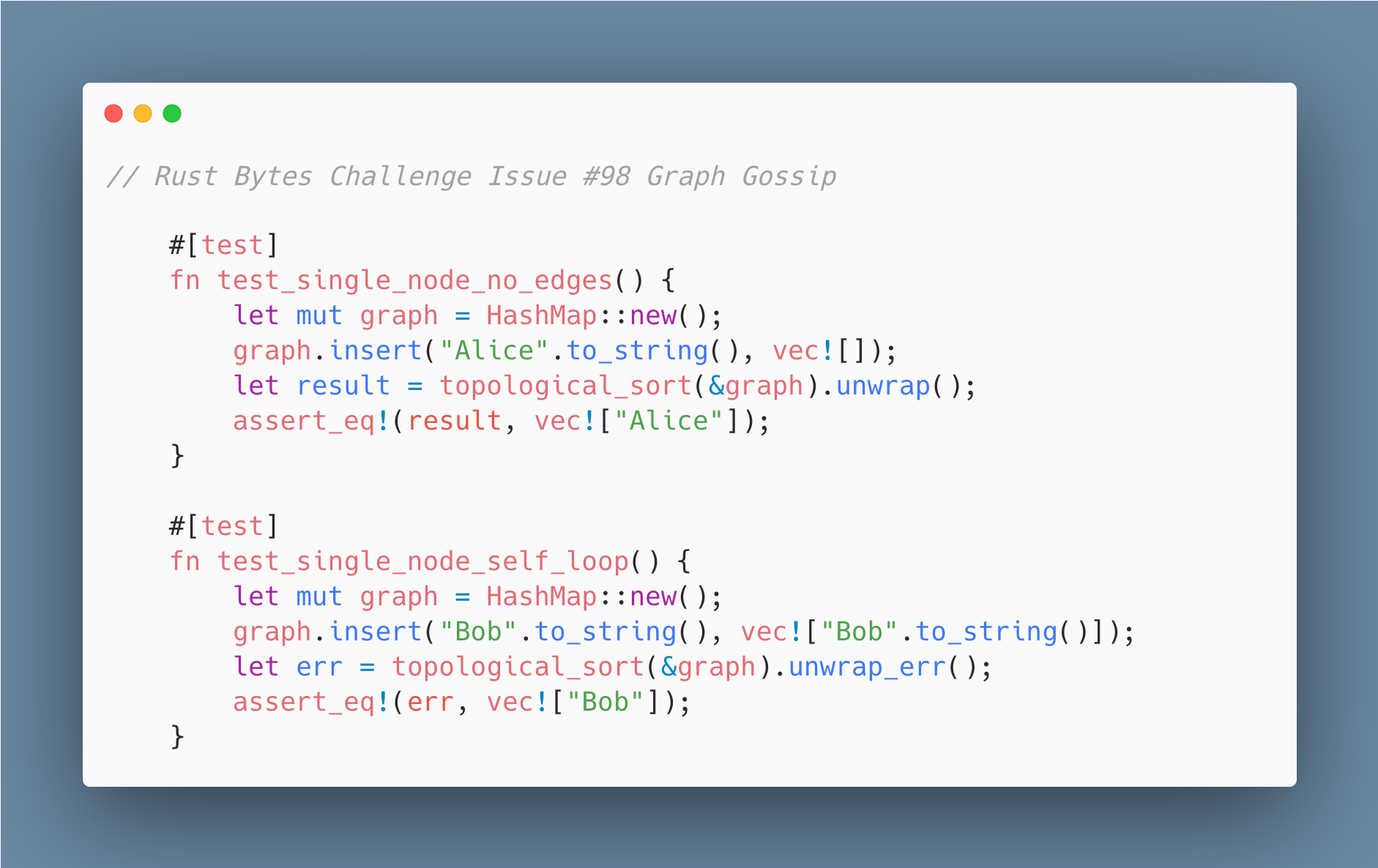
Test your solution on Rust Playground. Once completed, please share your solution and tag us either on X, BlueSky, Mastodon, LinkedIn, or reply to this email.
PROJECT SPOTLIGHT 💡
Cobalt.rs

Cobalt is a static site generator designed to streamline your workflow. While Zola is an excellent choice, it doesn’t fit every project. If you’re looking for an alternative, Cobalt is a practical fit.
Many static site generators suffer from bloated plugins that fail unpredictably, intricate configurations, and lengthy build times. Cobalt solves these issues, helping you deliver clean, secure sites that load quickly and scale effortlessly.
Here’s what sets Cobalt apart:
Dead-Simple Workflow - Start with an intuitive CLI. Use one command with no complex setup, and begin templating with Liquid right away.
Scales Without the Sweat - It works for small landing pages and larger multi-page sites without issues. Builds complete without memory errors.
Theme It Your Way - Use ready-made themes or make your own adjustments. Includes CSS syntax highlighting. Customization is straightforward.
Cobalt is open-source and available on GitHub at https://github.com/cobalt-org/cobalt.rs.
AWESOME LINKS OF THE WEEK 🔗
The Rust Vision Doc group has released “What Do People Love About Rust?” , and also Rustup 1.29.0 beta is now available for testing!
ETH Zurich Programming Language Foundations Lab published how to use Miri to exhaustively detects undefined behavior via pointer provenance, type invariants, and data-race simulation.
Rust joined the Linux kernel mainline last week and immediately checked off a rite of passage: its first CVE.
Guillaume Gomez wrote how Rust’s GCC backend bridges the compiler’s AST to libgccjit for targeting old processors unsupported by LLVM, enabling optimizations like nonnull attributes, unlike the separate gccrs frontend.
Your favorite open-sourcerer, Andrew Gallant (aka BurntSushi), got interviewed with Canonical about his work on ripgrep, the tool that made
grepfeel slow. [video]Rust Coreutils v 0.5.0 has achieved 87.75% compatibility with GNU Coreutils, plus Unicode and text processing enhancements, and performance and security improvements.
When Scope Lies: The Wildcard Pattern Drop Footgun in Rust reveals how _ wildcard in destructuring delays Drop calls, causing async shutdown leaks.
John Nunley shows how Rust’s “Block Pattern” uses simple code blocks to limit changes, delay setups until needed, and create cleaner, self-explanatory code for managing resources and cleanup.
The team at Turso has open-sourced AgentFS, a filesystem explicitly designed for AI agents.
At this year’s P99 conference, Alexey Milovidov from ClickHouse gave a talk on ClickHouse’s C++ & Rust journey of gradually introducing Rust into their 1.5 million-line C++ codebase. [video]
Bonus:
We open-sourced Bytes, a collection of resources we tap to snag the latest Rust content for this newsletter. It’s just fair that you hit that star button!
CodeCrafters: Become a Better Rust Engineer
CodeCrafters created amazing Rust courses that push your skills beyond the basics.
You’ll have fun building real-world projects from scratch, including Git, Docker, Redis, Kafka, SQLite, Grep, BitTorrent, HTTP Server, an Interpreter, and DNS.
The courses are self-paced, so you can learn at your own speed.
Join for free and get 40% off when you upgrade. [affiliate]
SUPPORT RUST BYTES
You’re Rust Bytes’ biggest fans, and we love to see it.
Here’s how you can help:
❤️ Recommend Rust Bytes to your friends.
🤳 Connect with us on our socials: X, BlueSky, Mastodon, LinkedIn.
☕️ Buy our editors coffee.
📨 Email us at rustaceanseditors@gmail.com for sponsorship, feedback or ideas.
I’m getting ready to write my year in review and figuring out what’s truly worth reflecting on.
That's all for now, Rustaceans.
John & Elley.