
🦀 What’s New in Rust 1.93.0
Today’s issue: AI Should Write Rust and Only Rust, Yarn’s Rust rewrite, and Stabilizing If-Let Guard


Happy new month Rustaceans!
In this issue, we’ll highlight the recently released Rust v1.93.0, present a Rust tip to you, spotlight an amazing project, and share 10 incredible links of the week.
Here’s issue #104
MAIN NEWS
What’s New in Rust 1.93.0
Last week the Rust team announced Rust 1.93.0 which is the first release of the year, and the headline is the musl bump to 1.2.5.
The release introduced a new musl DNS resolver to handle big records and recursive nameservers.
And if you’re building fully static binaries for Linux, networking just got a lot less flaky thanks to improvements made to musl's DNS resolver which shipped in 1.2.4 and received bug fixes in 1.2.5.
The only catch was some old compatibility symbols got removed, but libc fixed that over two years ago, so if you’re still on old dependencies… you need not to worry.
Next up, a small but delicious quality-of-life win: you can finally put #[cfg] on individual lines inside asm! blocks.
No more copy-pasting giant assembly blobs just to conditionally include one instruction. It’s the kind of change that makes you wonder how we lived without it.
And then there’s over 23 stabilized APIs. MaybeUninit got new safe helpers like assume_init_ref, assume_init_mut, and slice-copy/clone methods, perfect for when you’re juggling uninitialized memory but don’t want to sprinkle unsafe everywhere.
String and Vec also now have into_raw_parts, unchecked integer operations are officially blessed, and slices/ptrs can turn into arrays.
Oh, and custom global allocators can finally use thread_local!. Low-level hackers, your lives just got marginally less terrifying.
All in all, this release feels like the Rust team quietly cleaning up the sharp edges we keep cutting ourselves on.
RUST TIP 🦀
Last week we shared a Rust tip on safely adding new public fields later without breaking existing code. Now on to this week’s Rust tip.
bool::then: Lazy Option Creation
bool::then can be used as an alternative to if-else when building Option<T> conditionally.
It’s also lazy, so the closure only runs if true, skipping all work (allocations, I/O, heavy calculations) when false.
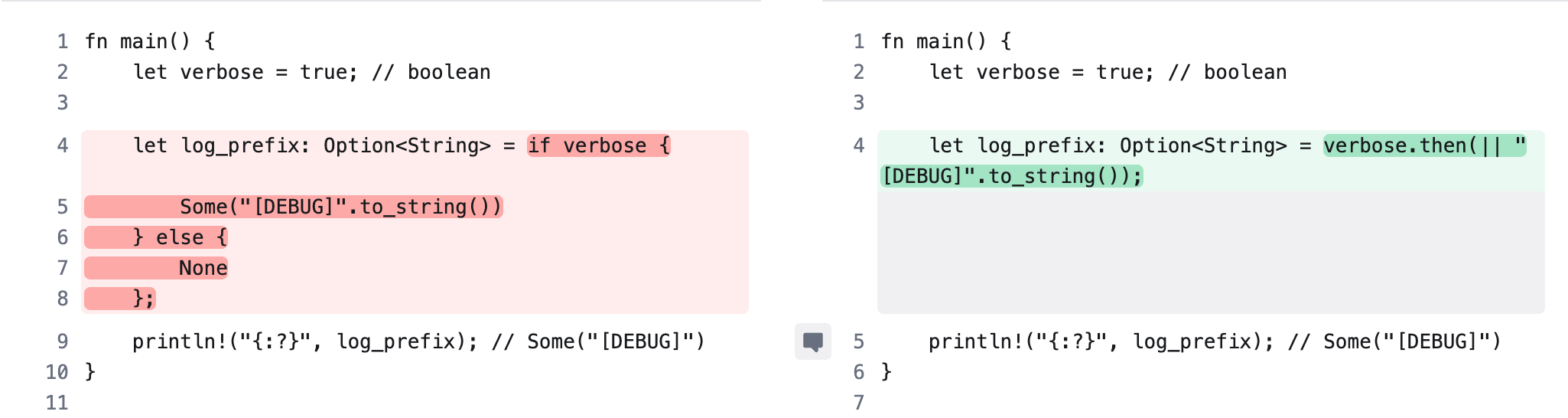
You can play around with the code on Rust Playground.
See the Rust reference for bool::then. https://doc.rust-lang.org/std/primitive.bool.html#method.then.
PROJECT SPOTLIGHT 💡
Yashiki

Yashiki is a macOS tiling window manager written in Rust.
It tackles the core frustrations of rigid workspaces, broken multi-monitor handling, and the inability to truly customize layouts.
What makes it worth installing:
External layout engines - Write layouts in literally any language via a simple stdin/stdout JSON protocol.
Bitmask tags - Windows can live on multiple tags simultaneously, and each display gets independent tag sets.
Shell-based config - Your ~/.config/yashiki/init is just a shell script. No Lua, no custom DSL, just plain sh commands.
This project is still early days (v0.9.4 was just released), but the foundation is solid and the direction is pragmatic.
Check out the project at https://github.com/typester/yashiki.
AWESOME LINKS OF THE WEEK 🔗
The Rust Foundation Project Directors published the 2025 Rust Foundation Annual Report Project Director Update.
Lucas Gelfond released zerobrew, a Rust-powered, drop-in Homebrew alternative that’s 5–20× faster. Same brew, way less waiting.
WhatsApp rolled out a Rust-based media library for malware protection, enhancing security across billions of devices globally.
Yarn previewed its Rust rewrite, bringing Lazy Installs and Yarn Switch for a serious performance boost. Stable is expected in Q3 2026, and apparently it’s already faster than pnpm.
Cam Pedersen’s Parametric CAD in Rust, introduces vcad: a Rust library for parametric CAD, enabling code-based creation of 3D parts via primitives, booleans, transforms, and STL/glTF exports.
Antoine Vandecrème’s article on rust closures is the last writeup you’ll need to understand closure: capture by ref/mut/value, traits (FnOnce, FnMut, Fn), move keyword for ownership, and desugaring examples.
Kivo wrote about a long-standing issue on stabilizing Rust’s ‘if let guard’: how it enables let patterns in match guards, fixes drop orders, and compatibility with let chains across editions.
Warre Snaet built an end-to-end ML pipeline entirely in Rust using the Burn framework, deployed it to his iPhone 12 via Tauri, and achieved inference times that make PyTorch look like it’s running on a potato.
Patrick Gray gave a talk arguing for using Rust with AI to write safe, fast systems code while covering practical Rust-AI integration and developer ergonomics. [video]
The Hidden Bottleneck: Blocking in Async Rust shows how blocking in async Rust causes latency spikes in Tokio without errors. It recommends using eBPF tool ‘hud’ to detect and fix culprits without code changes.
CodeCrafters: Become a Better Rust Engineer
CodeCrafters created amazing Rust courses that push your skills beyond the basics.
You’ll have fun building real-world projects from scratch, including Git, Docker, Redis, Kafka, SQLite, Grep, BitTorrent, HTTP Server, an Interpreter, and DNS.
The courses are self-paced, so you can learn at your own speed.
Join for free and get 40% off when you upgrade. [affiliate]
SUPPORT RUST BYTES
You’re Rust Bytes’ biggest fans, and we love to see it.
❤️ Recommend Rust Bytes to your friends.
🤳 Connect with us on our socials: X, BlueSky, Mastodon, LinkedIn.
☕️ Buy our editors coffee.
📨 Email us at rustaceanseditors@gmail.com for sponsorship, feedback or ideas.
Had a productive week, got more work done and started learning chess. Baby steps you’d say.
That's all for now, Rustaceans.
John & Elley.
Lovedthe musl DNS resolver update, finally fixes those weird networking issues I kept hitting with static binaries. The bool::then pattern is actually pretty slick for avoiding unnecesary allocations, been using if-else for this forever and dunno why I never thought about laziness there.