
🦀 Why Ladybird Is Moving Core Systems to Rust
Today’s issue: What It Means Now That Ubuntu’s Betting on Rust, How to Run Terminal Apps Anywhere, and Why Wait-Free Memory Reclamation Is the Kind of Chaos We Actually Like


Happy new month, Rustacean!
In this issue, we’ll look at why Ladybird browser is migrating to Rust, present a Rust tip to you, spotlight an amazing project, and share 10 incredible links of the week.
Here’s issue 108.
MAIN NEWS
Why Ladybird Is Moving Core Systems to Rust
Last week, Andreas Kling (Ladybird founder) announced a significant shift: the project is pivoting from C++ to Rust for some of its core elements. This move has triggered debate across the Rust and browser communities.
The transition was notably accelerated by AI (Claude and Codex), large portions were AI-generated under direct human supervision and review. Andreas mentioned that the team initially tried Swift for the task but encountered major issues with C++ foreign function interface (FFI) interoperability.
Switching to Rust proved to be a mature choice: its FFI integrated seamlessly with C++, and Rust’s memory safety guarantees added substantial value.
The focus was on LibJS, Ladybird’s JavaScript engine. In just two weeks, the team ported 25,000 lines of code.
The results were impressive: the new version produced byte-for-byte identical abstract syntax trees (ASTs) and bytecode, with zero regressions across 52,898 Test262 suite tests and 12,461 internal tests while performance remained unchanged.
For now, the code maintains a translated style to ensure compatibility, but the team plans idiomatic Rust refinements once C++ is fully phased out.
Ladybird’s approach follows in the footsteps of browsers like Firefox and Chromium, which have already integrated Rust components.
The shift away from Swift stemmed purely from interop challenges. Importantly, this is an experimental side project rather than a complete overhaul of the browser.
Within the Rust ecosystem, opinions are divided. Enthusiasts praise the process as a “10x reduction” in effort, celebrating the efficiency gains. Some however criticize the reliance on AI-generated “slop” and raise concerns about long-term maintainability.
I view this as a promising blend of AI and human expertise. The initial non-idiomatic code emphasizes the importance of ongoing refinement to truly take advantage of Rust’s strengths.
RUST TIP 🦀
Last week we shared a tip on when to prefer From/TryFrom over as.
This week’s tip is from John Arundel, Rust teacher and author of The Rust Spellbook. Rust Bytes readers get 10% off with code BYTES26.
Use checked_add to avoid overflow
Rust lets you write arithmetic that might overflow:
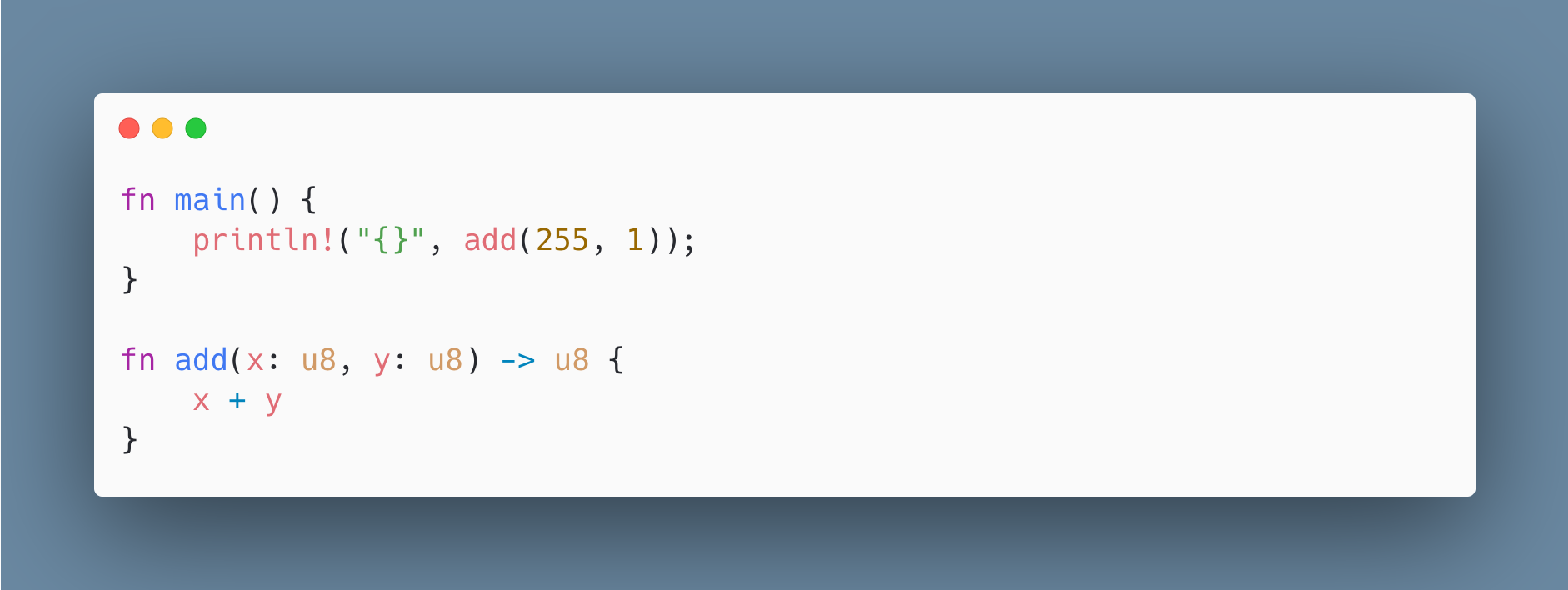
What happens? Nothing good.
In debug builds, this panics. In release, it silently wraps around and prints:
0That’s rarely what you meant.
Instead, use checked arithmetic. Methods like checked_add return an Option:
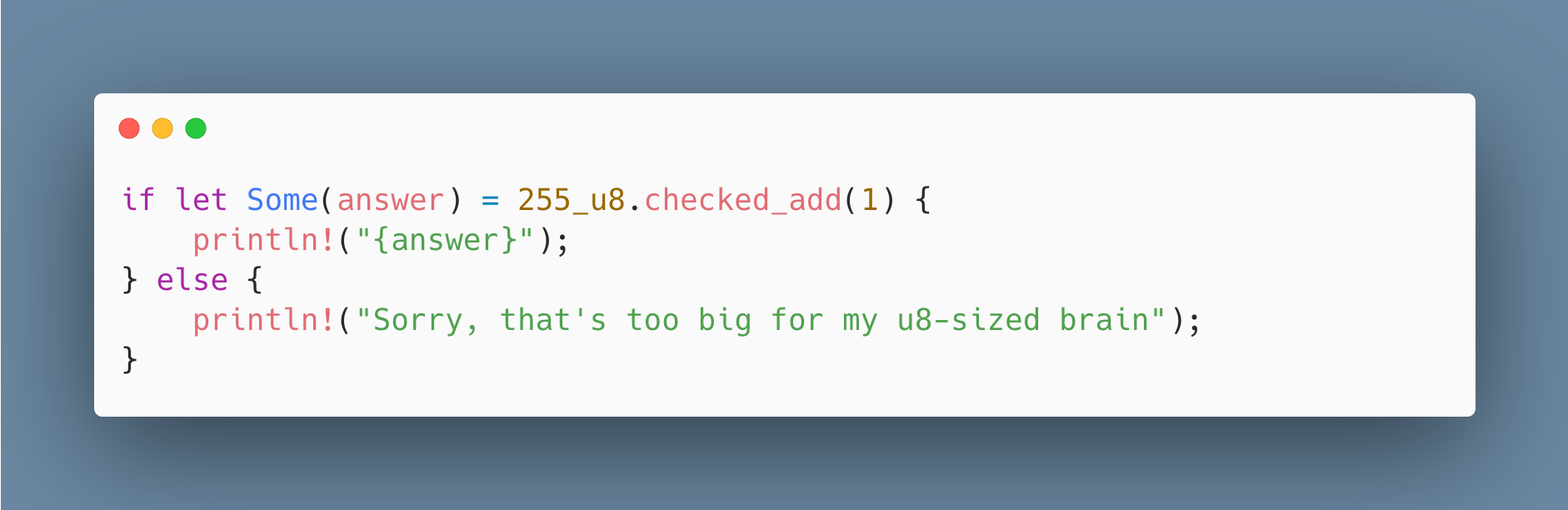
If the result fits, you get Some(answer). If it doesn’t, you get None, and a chance to handle the error properly.
Good programs don’t rely on luck. Use checked arithmetic when correctness matters.
PROJECT SPOTLIGHT 💡
Godot CEF

Godot CEF is a high-performance Chromium Embedded Framework (CEF) integration for Godot Engine 4.5+, written in Rust.
Render web content directly inside your Godot games and applications with full support for modern web standards, JavaScript, HTML5, and CSS3.
What makes it awesome? Here’s the shortlist:
GPU-accelerated off-screen rendering. Crank up the frames with native APIs, so your web textures render in 3D.
Typed IPC with no JSON overhead. Swap data between JS and GDScript using primitives and buffers minus the serialization drama.
Auto-fallback to software mode. When hardware acts up, it switches seamlessly, keeping your app alive instead of crashing.
Godot CEF is open-source on GitHub at https://github.com/dsh0416/godot-cef.
AWESOME LINKS OF THE WEEK 🔗
The Rust compiler team launched the 2026 debugging survey to identify pain points and improve async support, visualizers, cross-debugger compatibility, and cross-platform capabilities.
Cold-string is yet another compact Rust representation for immutable UTF-8 strings. The pitch? Squeeze memory harder and pack structs tighter.
Niko Matsakis argues in “What it means that Ubuntu is using Rust” that Ubuntu’s adoption bridges the chasm to mainstream Linux; Rust must adapt std lib, seek investments, and foster empathy for growth.
Shuxian Wang from Antithesis wrote “Formal Methods for the Unsafe Side of the Force”, explaining RustBelt proofs enabling SendWrapper and MainThreadToken to safely use non-thread-safe C++ in async Rust.
The Fish shell team released version 4.0, featuring enhanced keybindings, tighter terminal integration, improved scripting, and better portability.
Apache Iggy migrated from Tokio to thread-per-core architecture with io_uring for superior performance, selecting compio after evaluations, yielding significant throughput and latency gains.
Weedon & Scott open-sourced trolley, a tool that bundles your TUI app with a terminal emulator, so you can ship it to non-technical users without explaining what “open a terminal” means.
Theo M. Bulut’s “From Production MVCC Systems to Wait-Free Memory Reclamation” introduces a crate fixing lock-free memory leaks via wait-free guarantees, with benchmarks, and TLA+ verification.
Ivan took a swing at memory pressure and data-oriented design, and didn’t miss. Turns out, when you stop fighting the cache and start feeding it properly, the CPU actually does its job. Who knew?
All the talks from RustNation 2026 are officially live. Missed the conference? No worries, now you can catch up in sweatpants with a debugger open. [video]
CodeCrafters: Become a Better Rust Engineer
CodeCrafters created amazing Rust courses that push your skills beyond the basics.
You’ll have fun building real-world projects from scratch, including Git, Docker, Redis, Kafka, SQLite, Grep, BitTorrent, HTTP Server, an Interpreter, and DNS.
The courses are self-paced, so you can learn at your own speed.
Join for free and get 40% off when you upgrade. [affiliate]
SUPPORT RUST BYTES
You’re the biggest fans of Rust Bytes, and we love it.
❤️ Recommend Rust Bytes to your friends.
🤳 Connect with us on our socials: X, BlueSky, Mastodon, LinkedIn.
☕️ Buy our editors coffee.
📨 Email us at rustaceanseditors@gmail.com for sponsorship, feedback or ideas.
I’ve been listening to Mimi Webb while editing this issue.
Wishing you a productive month of March, plenty of good laughs, and take care of yourself.
That's all for now, Rustaceans.
John & Elley.